Saturday, June 11, 2011

Tree of Life


Terrance Malick's Tree of Life is probably the most interesting film experience I've ever had that I cannot recommend. People should know they are wandering into a two-and-a-half-hour tone poem where nothing much happens. The "story," if you can call it that, concerns an aging Sean Penn who thinks back on his childhood and relives his relationship with his younger brother, when they were still innocent, years before that brother would go off to Vietnam and get killed. Penn's younger self is shaped mostly by his overbearing disciplinarian father, played by Brad Pitt. But Malick doesn't start there. No, he has to start earlier than that to tell this story properly. He must begin at the beginning of the universe.


About fifteen minutes into this Dawn of Man sequence people started filing out of the theater. There was open laughter, and then more filing out, probably 15 people or so in total. And still the earth's molten core was forming and the oceans were spewing and microbial life was wiggling and cells were dividing. Then there were CGI dinosaurs, and more laughter from a pocket of soon-to-depart folks. In some ways Tree of Life owes more of a debt to 2001 -- even Solaris -- than it does to Revolutionary Road or any other family melodramas from the period.

I found it mesmerizing.


K noted: "The problem is that this is a movie, so it's being marketed as a movie. If this were an art installation you saw at MoMA you'd adore it." I'd have to agree with that. People can't wrap their heads around it because it's like no movie they've ever seen. There's no plot or rising action or red herrings or anything dependable that Robert McKee or Gustav Freytag would use to build a narrative. It's an art event, not traditional storytelling.


But it's amazing in its own way. Malick is unafraid to go from macro to micro in one edit, from the dawn of the universe to the tiny insignificant details that make up this cosmic infinity -- a frog tied to a toy rocket, a mother's hemline, a neighbor's lingerie spread out on a bed, a tiny newborn foot cupped in two hands. I was browsing a review complaining that when all was said and done Tree of Life was just a scrapbook of pretty pictures. Is that not enough? Tree of Life IS a scrapbook -- the cinematography (shot completely without artificial film lighting) is remarkable -- and it catalogues everything about these lives, and life in general. Tree of Life is a celebration of what it is to be alive -- all of life's grand moments and banalities and emotion and dread in two and a half hours. It is by turns operatic and very still and quiet. And it is boring, and it is long, but it is definitely the film I'd put on the Golden DVD for the next Voyager spacecraft, the film that most completely explains us to whatever space alien awaits us. It is somehow the film that most totally details how life works -- physically and metaphysically -- and, like life, it is not always entertaining.


I asked K whether films like this would still be made ten years from now. She didn't think so. Malick is kind of a relic -- a true auteur -- and Tree of Life is the shotgun blast of an older director contemplating his mortality and the end of a filmmaking career. They shot multiple formats of film (35mm, 65mm, and IMAX -- over a million feet), and used no film lights. Malick is famous for shooting at magic hour -- 45 minutes a day -- on sections of Days of Heaven... to get the soft post-dusk lighting just right. On Tree of Life if it was cloudy and they were doing interiors they'd find something else to shoot. Or just come back the next day and hope for the best. Directors who came up in the 70s -- when there was more freedom and auteur theory was in vogue -- still cling to this control. Directors coming up now will never have this control, or this desire to have this control. They will be cutting different versions for test audiences.


I skimmed a few review quotes of this film and the word "pretentious" seemed to crop of up quite a bit. I actually think that Tree of Life is the opposite of pretension -- Malick made a film that only he could make. It's shockingly personal when you think about it. Malick's entire being is in this film. How often does a director so completely imprint his soul on a motion picture so that you feel like you know him personally? There's nothing pretentious about it. Bombastic maybe. Overreaching, sure. I myself will probably never want to sit through it again, but I'm so glad I went to see it in the theater because such a film could never be tolerated on DVD with all of one's household and its distractions circling.


So I refuse to recommend this movie -- or "art experience" -- because I think it IS problematic. It rides the razor's edge between laughable and laudable; on a different day I might be tittering in the dark and slinking out with everyone else. Tree of Life is big and baggy and messy and inspired and lyrical and tedious... and uneven and beautiful too.

Just like life.

Wednesday, June 01, 2011

Confronting the Invasive: Technology, Parenting, and Shrinking Spaces in the Age of Total Interconnectivity

My brother and I often remark that we were born at the perfect point in history. Our childhoods were gloriously free of cell phones and the Interwebs; we had to go outside to play, or if we wanted to use the computer we had code our own primitive games in BASIC on the family TRS-80. Now that we are adults, we are able to fully utilize the miracle of the Internet. And it IS a miracle, goddamnit. Just two days ago I dropped my iPhone in a parking lot, and not only did it shatter the touchscreen, but it jarred the SIM card loose and my phone wouldn't really function until I got home and Googled some solutions. I was able to fix the SIM card issue in about a minute, and an iPhone screen replacement kit is on its way. It cost $2. Miraculous!

--

Yesterday, K was ranting about kids sitting at restaurants ignoring their parents and playing on their phones.

K: Is it really necessary for that 8-year old to have a cell phone?
E: Of course it is. Otherwise he'll be ostracized at school! And what parent wants that?

--

I came across this article in the Daily Mail a while back called "How Children Lost the Right to Roam in Four Generations." The author tracks four generations in his wife's family and how far afield they were allowed to wander at the age of eight. In 1919, his wife's 8-year old grandfather was allowed to walk six miles, unsupervised, to his favorite fishing hole. In 1950 her eight-year-old father was allowed to walk a mile into the woods. The author's wife -- at age eight in 1979 -- was only able to travel a half-mile to the local swimming pool. Now the son of the author and his wife is only allowed to walk to the end of the block.

I'm not sure what it's like to be a kid in today's day and age. From my middle-aged perspective, it looks pretty bad -- although that's what every generation has been saying about the next for all of eternity. But it got me thinking that something has gone awry in our culture and it's only going to get worse. I saw this book today and thought I might read it as an antidote to the relentless Battle Hymn of the Tiger Mother (which I shall blog about soon). Of course, it's the easiest thing in the world to theorize about parenting, and another thing totally to just survive the mayhem -- and it's still another thing to comment on all of these issues without actually being a parent.

Perhaps the lifestyle change between my childhood and today's childhood's has more to do with the change between my suburban upbringing and the highly urbanized environment I live in now. Perhaps I should check my premises. Perhaps my sample size is too small. Perhaps the people who surround me are overprotective because they live in Los Angeles, and not because all parents helicopter over their children these days.

Perhaps Middlebrow will finally write his book "Parenting Without Principles" that he pitched to me once. I think I would like to read that.

Kids today.... (sigh, grumble)

Sunday, May 29, 2011

Tim Burton Broke My Heart


K and I went to the Tim Burton exhibition at LACMA today, which I believe is the same one put together by MoMA back in 2009. I don't think I've ever seen so many people at a museum. There was a one-hour-plus line to get Mr. Burton's new book signed. We didn't do this. Plenty of young goth girls did, though. Some dressed up in dark-and-stripey Burtonesque attire for the event. (These are not my photos, by the way.)


I have an uneasy relationship with Mr. Burton, having been something of a fanboy back in high school and early college. When you revisit his early work, it's hard not to have the same impression. At the time, he was such a fresh and visual young presence in the film world. Looking back, it seems truly insane that this young Disney animator was tapped to reinvent the Batman franchise.


It has become clear, however, that Burton is very weak on narrative. Very. I don't think he can tell a story properly, which is really the whole thing, isn't it? I actually walked out after an hour of Sweeney Todd; I couldn't take Big Fish, either. I did enjoy Corpse Bride, which he co-directed, but it's been since 1990 (Edward Scissorhands) since I've been able to endorse any of his films--and even this, I'm sure, doesn't really hold up. Indeed, if you go back far enough, I'm willing to bet that Pee-Wee's Big Adventure is the only film of his that stands the test of time.


The Nightmare Before Christmas is still as fantastic ever, but I attribute this to genius director Henry Selick, who keeps the story moving along and the puppet characters emotional and interesting. There is a great note in the show from Selick to Burton about changes he wants to make during Jack Skellington's "Jack's Lament" song. He signs his note: "Respectfully, Henry S." I love that!


Still, the exhibit is inspiring for the sheer volume of art that Burton has created over the years. He draws because he must draw, and although much of the show is made up of doodles and sketches, there are some finished pieces supported by acrylics or watercolors that are remarkable. He also completed a series of large-format Polaroids (24x20) that are truly beautiful -- gloriously saturated and staged, with inches of ginormous Polaroid goop encroaching on the edges of the frame. No, a digital camera can't and will not ever be able to come close to this.


This feels like the best way to access Burton's mind: as framed visual pieces that the viewer can spend a lot of time or a little bit of time on. There's no story to contend with -- no tension, no rising action, no conflict, nothing. It's visual candy, and a lot of it, and the viewer is free to linger or leave -- as he or she sees fit. The opposite of being chained to your theater seat and enduring slack editing and dialed-in performances just to have the crazy design rationed out to you over two-plus hours. Perfect!


After shoving our way through the dense crowds of fans opening up their wallets at the exhibit-ending, money-making Tim Burton store, we head over to Ray's, based on Hightouch's thumbs-up, but there was a 45-minute wait, so we camped out in the bar and had some snacks instead. Perhaps next time!


I noticed in my literature that there's a Tim Burton film retrospective at LACMA's Bing Theater over the coming weeks, which seems appropriate. For a moment, I thought I might try to rekindle the old enthusiasm and see some of these films big. If I were twenty-five and idle I might take up this task. As it is, we're probably going to give it a miss...


Tuesday, May 24, 2011

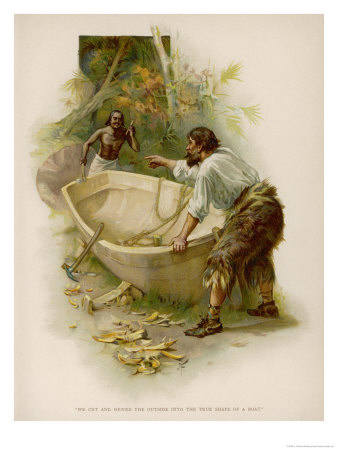
Robinson Crusoe: Productivity Guru

Jonathan Franzen's remarkable New Yorker essay, "Farther Away," packs more life into its few pages than his new novel Freedom does in its 600 or so pages. After finishing the interminable slog of his latest book tour, Franzen visits Masafuera, the island off the Chilean coast where the "original" Robinson Crusoe spent four years surviving off the land. Franzen brings along the ashes of writer David Foster Wallace to dispose of into the Pacific Ocean. What starts out as kind of a quirky travelogue segues into an analysis of the English novel and individualism, and finally settles in as a meditation on loss.


It seems that Crusoe is really used as a device here to connect these things -- his journey to a far-off island and his need to contemplate the recent death of a good friend. This essay isn't really about Robinson Crusoe, but that is the vehicle we ride in to get to some other, more penetrating places.


And yet, after reading "Farther Away," I found myself wanting to read Crusoe, having never thought it an important read and having never have had to study it in school. And what a weird pleasure it was to do so! I don't know what I was expecting -- some kind of juvenile, swashbuckling picaresque, I suppose -- but what I got instead was a proto-Walden, a flat journalistic listing of crop rotation and canoe building and hut manufacture. But sort of fascinating too, like an 18th century Getting Things Done.


Rob is all about breaking his day into chunks and maximizing productivity, spending his mornings hunting, the midday hours performing chores around the house (while it's too hot to do anything else), and then spending the afternoons going out again and performing tasks at his second residence or in his fields. For a novel with such a reputation as a ripping yarn, Defoe delivers Crusoe's journal entries without any affect or embellishment -- it's simply an accounting of goods and tasks and results. More ledger than poetry, certainly. And yet, there's something gripping about it too, especially for a productivity nerd like myself.

Rob made the most of his days. Surprisingly, he doesn't look outward that much -- he gets closer to God, sure, and he's conscious of some kind of cultural relativism (when questioning his own personal moral indignation to viewing cannibalism first-hand), but there isn't as much imagination and lyricism and philosophy as one might expect for a twenty-eight year castaway. The descriptions are of how he built a canoe, from what tree, and how he hollowed it out... instead of descriptions of weather and sunsets and inner turmoil.


So let us celebrate the Protestant work ethic. And let us celebrate manual competency! Let us not celebrate the poopy film versions on offer (Aidan Quinn or Pierce Brosnan?), however. If anyone knows of anything superior, please let me know. In the meantime I may finally try out Castaway after all of these years. I'm sure Defoe would consider watching any of these offerings to be a total waste of time. And he'd probably be right.

Friday, May 20, 2011

Sedona: A Photo Essay

K wrangled some free-ish accommodations from her good friend, so we set out last Thursday, inappropriately early, for the eight-hour drive to Sedona, to celebrate my 40th birthday and to be in a place where our lives would improve radically for the next few days, only to backslide to normalcy upon returning.


Lunch in Kingman was mediocre, but the Roadrunner cafe was greasy enough to satisfy. "What a cute tiny desert community," we thought, then went over the hill to see Kingman proper, which felt a lot like Barstow.


We missed the cutoff to Sedona, but Karen found something called Schnebly Road, which would shuttle us straight across. A local road, fifteen minutes max, right? Then the pavement went away, replaced with rocks and cattle guards, and pink jeeps with tourists taking pictures. Twenty minutes later trees opened up and a canyon advanced quickly and I got a crazy feeling of vertigo as the universe opened up before us.


Then we got out and took pictures.

After a few minutes of this I captained my Soobie down the increasingly rugged Schnebly Hil, which took another 40 minutes or so, averaging speeds of 5 mph or so. Damn you, Schnebly!


Sedona is an amazing place, no doubt.


There is plenty of strange foliage, and many strange people too.


There are UFOs and places for these spacecraft to land on.


The best thing is: Sedona makes you feel really small. This is a good thing, because as a human I am fairly huge. K calls me a lummox from time to time, but that is another story. Still, it is hard not to contemplate the universe when you are reduced to antlike status by your environment, especially by something or someone other than your wife.


Then there are the energy vortexes (vortices, dammit), which may or may not exist. The theory is that this energy causes the trees to spiral all crazy. I started out as a Vortex Skeptic, but then converted to belief when an argument seemed imminent. And it did give me a lot of positive energy to not bicker about vortices, so there must be something to it.


Even Sleepy-E had to contemplate the universe when the sun went down and everybody went back to their resorts. He made a promise to have more quiet in his life instead of constantly filling it with podcasts and DVD bonus features and even music. He also committed to start writing about himself in the third person when things got too personal.


This is what happens when you put your inexpensive point-and-shoot camera into one of those coin-operated set of binoculars up at the airport. It is hard to prevent the round vignette from making you think about action/adventure films, or the lackluster Shelly Long comedy, Outrageous Fortune.


After three nights of rejuvenation and hiking and lounging, K wanted to stop in Flagstaff on the way back. What could possibly be in Flagstaff ?


Only the cutest little downtown and a spectacular breakfast at a new place called El Criollo. Or is it just Criollo? I had blue corn blueberry pancakes and Amazing Bacon (my caps). Karen had something called the Haitian; I cannot remember what it was, but it was sublime.


I actually think that Flagstaff wins in many ways over Sedona: it's a college town, with a functioning downtown, and better food too, perhaps, and cheaper too. Maybe it just reminded me of college, I don't know. The landscape of Sedona is unparalleled, but Flagstaff is cute too.

After breakfast we drove home. The Soobie was punished but she performed well on the hostile backroads of northern Arizona. My car has been vindicated and now I feel like a million dollars.


Now I can go back to my humdrum existence! An article in the Boston Globe a while back argued that more short, intense vacations produce more overall happiness than fewer longer vacations. A three-week vacation doesn't provide a proportional increase of happiness over a one-week vacation. You are better off taking short and intense vacations, and more of them.

So that is what we will do.

Sunday, May 15, 2011

Halftime (Long)

I turned forty last week. It feels like halftime. A brief reprieve before the stressful grind of the third quarter commences, when we try to chip away—Seattle Supersonics style—at the lousy deficit earned during the first two poorly played quarters. And so far it does feel a lot like halftime—I can ratchet up that false optimism, and listen to motivational speakers (Coach), have a loungy rest, joke with friends, and have a drink or two (if I’m Ron Artest).


I actually enjoyed turning thirty, and was confronted by none of the aging angst I had expected for that milestone. All of that returned during my thirty-first year, when it became clear that nothing was different, I wasn’t older and wiser (just older), and that my thirties were just an extended version of my lackluster twenties, without the sheen and polish—a new time when I would start to buy Glucosamine for creaky joints and when bran intake would become a legitimate topic of conversation. This third and fourth quarter, however, will not stretch into infinity with time-outs and TV breaks and attempts to ice the shooter. It will be played with a running clock, and when it is over, it is over.

A great man once told me that turning forty was the best thing that ever happened to him. I am paraphrasing here, but basically he said that turning forty causes you to come to terms with yourself. All of that STRIVING and VAGUE DISSATISFACTION kind of fades away—if you aren’t a millionaire and a CEO yet, you probably aren’t going to be—and that’s okay, a good thing maybe. Come to grips with it! Turning forty makes you ask yourself: “Now what?” For him, the answer was: “Okay, now I can start having fun.” I suppose this is what a mid-life crisis is, but I don’t think he was out buying convertibles and leisure suits and trying desperately to turn back the clock with material goods and rowdy behavior. That sounds a bit dramatic. For my father, he was able to make peace with his job, that this was what it was, and that the most important thing was to be a good father and to enjoy life every day.

I will say this: The past few years it has become clear that time is not infinite, and that I’ll probably never learn Sanskrit, and if I do it’ll be at an extremely high cost. Saying yes to one thing means saying no to a dozen other things, and turning forty is just another blunt reminder that you can’t say yes to everything (although my lengthening to-do list seems to be in total denial about this). Do I want to work on a novel for two years or do something more productive with my time? Or twenty smaller things? Much of my thirties was spent making a certain documentary, and now that it is over it has been so pleasurable—delicious, really—to just focus on little non-artistic domestic tasks—doing chores around the house, cooking more and more, starting a garden on the balcony, etc. I’d still like to work on a book; I just feel like I need to decide that spending this time in this way is important, and correct, and then stick with this decision. Of course, this RAISING OF THE STAKES contributes to total artistic paralysis—if every creative endeavor has to be sanctioned by the time-management committee in your head. But that is a topic for a future blog post!

From Paul Bowles’ The Sheltering Sky : “We get to think of life as an inexhaustible well. Yet everything happens a certain number of times, and a very small number, really. How many more times will you remember a certain afternoon of your childhood, some afternoon that's so deeply a part of your being that you can't even conceive of your life without it? Perhaps four or five times more. Perhaps not even. How many more times will you watch the full moon rise? Perhaps twenty. And yet it all seems limitless."

It is worth asking again: Now what?

Sunday, May 08, 2011

Rochester is Too Young

And too handsome. And too groomed.

They say you can divide the world into two camps: an Austen camp and a Bronte camp. Having never read Austen, believe it or not, and having come late in life to Jane Eyre, I tentatively put myself in the Bronte camp of brooding romantic gothicity, although I don't claim to be an expert.


So I wouldn't say that I'm attached to Jane Eyre in the same way I might have been had I read it in high school or college. But that doesn't prevent me from criticizing this new filmed adaptation, by Cary Fukunaga (Sin Nombre), and starring two hot young actors in roles for the plain and the ugly. I suppose the studio would never have allowed otherwise.

I've heard there is a 1996 version with William Hurt and Charlotte Gainsbourg, which, even if terrible, probably gets the age difference closer to the novel. Orson Welles seems like a better fit too, he's certainly big and boisterous and brooding, yes, and not so attractive in his later years, no. I will have to see Orson's scene-chewing performance in that earlier version. Welles liked his ham and he liked it big and that sort of thing would have breathed some much-needed life into this movie.


Micheal Fassbender makes googly-eyes at Mia Wasikowska,pretty much from the get-go, and the acting is fine and and the cinematography is handsome, sure, but the music is overwrought and the screenplay is questionable and the director Fukunaga doesn't get to the guts of the story in the way he should, merely fulfilling his duties as the person who films the scenes as written (or adapted).


Remains of the Day gets this notion of repressed, forbidden love way way better. Even Age of Innocence ratchets up this tension masterfully compared to this clunky mess. Near the end, after Jane returns to Rochester's burned-down mansion, she seems more like a young waif with a crush than the radical, noble individualist (and now a woman of means, with property) who's deciding her own fate and who's willing to accept a broken-down Rochester for what he is.


Indeed, this radical notion of individualism and a young female protagonist who speaks her mind and determines her own fate, with or without men involved, seems to be lost in this film. She seems passive, actually, even though she's given her requisite lines of saucy, impertinent dialogue. And when she's out flopping around on the moors, crying, it's a little hard for me to get behind it. Maybe if she were pining for Orson Welles! Or Al Pacino!


Finally, the house isn't scary enough, the crazy wife in the attic seems like an undeveloped afterthought, and the bizarre fortune teller scene (Rochester in drag!) has been cut to speed the story along.

Too bad, it could have been great!

Sunday, May 01, 2011

The Problem of Man Night

Over the past few months I've been organizing some "Man Nights," which started out as an excuse to get a few of the guys together to watch movies... but is evolving into some kind of curious, themed dinner party followed by an appropriate double-feature of male action or horror. Indeed, this could be one of the only contexts in which a man-centric dinner party would be possible without comment. Kind of a lowbrow version of Middlebrow's Beer and a Book group.


The first Man Night happened because we were all excited to see Werner Herzog's remake/homage/sequel Bad Lieutenant: Port of Call, which was as deliciously awful as predicted. The second started out with Evil Dead 2 and then fizzled out with the director's cut of Aliens. The last Man Night was supposed to be a Korean double-feature of Oldboy and The Host, preceded by Korean BBQ and soju consumption. A couple of my friends had seen Oldboy recently, however, so in the spirit of trying to watch something new, we viewed instead the first installment of Park Chan-wook's Vengeance trilogy, Sympathy Mr. Vengeance, followed by the relentless (yet still boring somehow) Thai actioner Ong-bak 2.


Both were awful; never again will we take a chance on films nobody has seen. From now on it's strictly revival screenings at Sleepy-E's place.

Anyway, we're looking for other appropriate pairings for upcoming Man Nights. I was considering Italian food and the Godfather. Or Shepherd's Pie for a Get Carter/Quadrophenia double? Any ideas?

Thursday, April 28, 2011

Golly!


Wait, and California's high-speed rail is getting the kibosh too?

Sunday, April 24, 2011

The Financial Lives of the Poets


National Book Award nominee Jess Walter's latest effort, The Financial Lives of the Poets, is the funniest thing I've read in a couple of years. The book kicks off with the hapless protagonist, Matt Prior, leaving his comfortable job right before the 2008 financial meltdown to start an online financial magazine written in verse, Poetfolio.com. Needless to say, Poetfolio is a bust and soon Matt faces imminent foreclosure on his house unless he can come up with his $30k balloon payment in a couple of weeks. But that is only one of his problems. His alienated wife is cheating on him with a former high school boyfriend who works at the hardware store. His senile father has moved into the living room. His kids demand electronics and their private school tuition. So Matt does what any sensible midlife person might do: He resorts to selling drugs.


Part Rabbit Redux (there's even a drug-fueled character named Skeet), part hapless Lucky Jim (to which all comic novels must be compared), with a dash of Nicholson Baker's The Anthologist thrown in. There's even a little Elmore Leonard in here in the group of stoner white punks he encounters at the 7-11 one night and in the two local good-cop/bad-cop policemen who entrap Matt but who may not be what they claim to be. This book has been compared to Weeds, but I can't vouch for that having never seen the program...


Fabulous, hilarious, dark, and moving. I'd quote the text more but I loaned my copy to a friend some time ago...